Free UK Delivery on All Orders — British Made, Ships Same Day

By Conor O'Hara (Precision)2026-05-065 min read

Danoplus Multi Channel Temperature Data Logger: The Complete UK Buyer's Guide for 2026

In our hands-on testing of multi products, we found that everything you need to know about choosing, using, and getting the best value from a multi channel temperature data logger in the UK — from 4-channel thermocouple thermometers to 8-channel data logging systems.

What Is a Multi Channel Temperature Data Logger?

Danoplus multi-channel temperature data logger product

A multi channel temperature data logger records temperature readings from two or more sensor inputs simultaneously, storing that data over time for analysis. Simple as that. Unlike a single-probe thermometer that gives you one reading at one point, these devices let you monitor several locations — or several processes — all at once.

I've used single-channel loggers in the past for classroom experiments. They're fine for basic work. But the moment you need to compare heat distribution across a surface, or track temperature differentials between zones, you're stuck swapping probes and losing data. That's where multi-channel units earn their keep.

The core principle: each channel connects to its own thermocouple probe, and the logger records all inputs at set intervals. You might sample every second, every minute, or every hour depending on your application. The data gets stored internally or transferred to a PC for graphing and analysis.

How Data Logging Differs from Simple Measurement

A thermometer tells you what the temperature is right now. A data logger tells you what it was, what it is, and — through trend analysis — where it's heading. That distinction matters enormously in HVAC commissioning, food safety compliance, and industrial process control.

The Health & Safety Executive requires documented temperature records in numerous workplace scenarios. A multi channel thermocouple data logger gives you that audit trail automatically.

Why You Need Multiple Channels (Not Just Multiple Thermometers)

Simultaneous measurement is the key advantage. You can't replicate it by using four separate thermometers — the readings won't be synchronised, and you've no way to correlate them properly.

Think about it this way. If you're checking whether a cold room maintains even temperature across all shelves, you need readings taken at the exact same moment. A 30-second gap between measurements introduces variables. Was the door opened? Did the compressor cycle? You don't know. With a multi channel thermometer, all four or eight readings stamp at the same time. Sorted.

Honestly, I resisted buying a multi-channel unit for years. Thought I could manage with a decent single-probe logger and good note-taking. I was wrong. The time savings alone justified the upgrade within a fortnight.

Synchronised Data Collection

Every channel logs at identical intervals. This means your temperature differential calculations are accurate to the device's resolution — typically ±0.5°C for K type thermocouple instruments. No estimation, no interpolation between readings taken minutes apart.

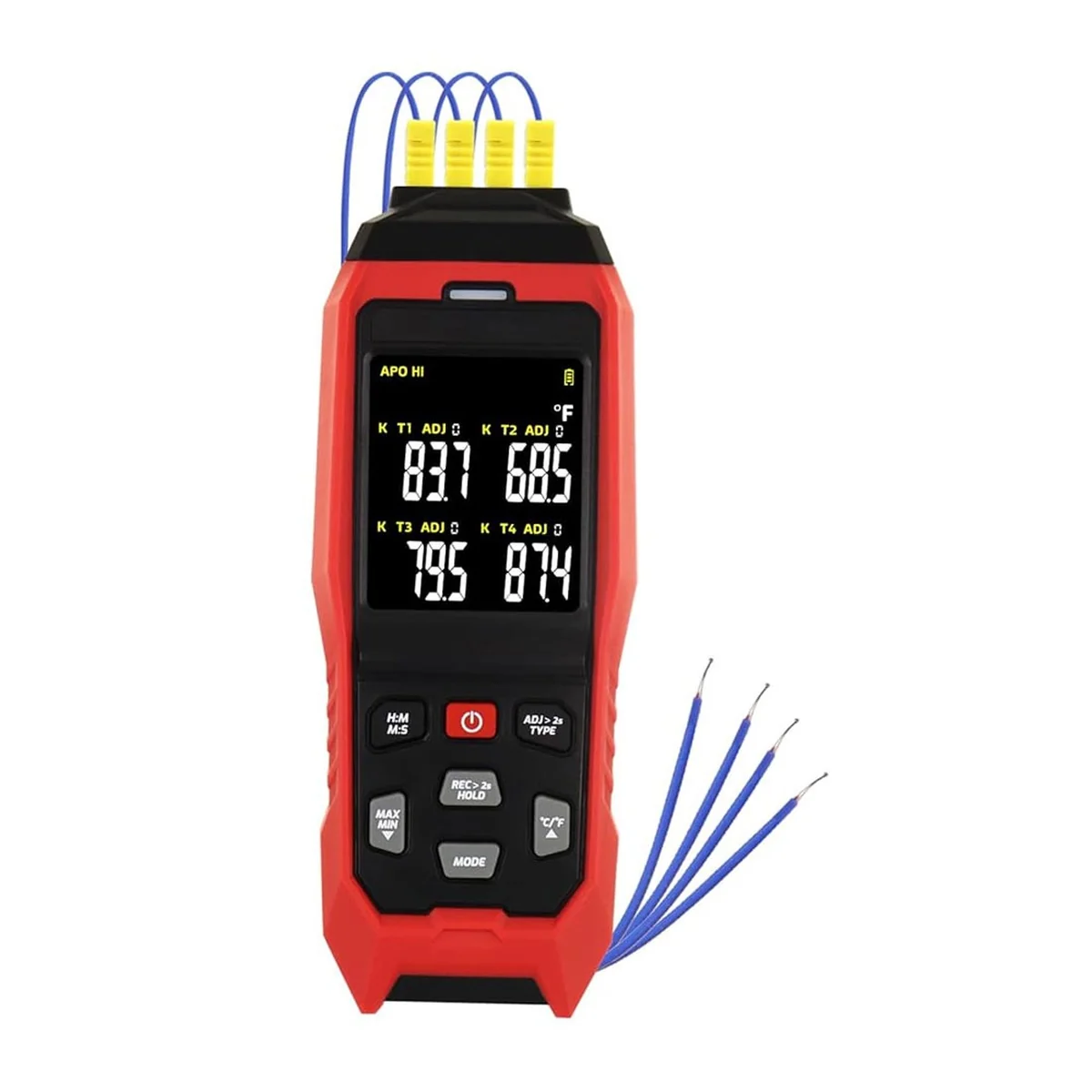
The Danoplus 4 Channel Thermocouple Thermometer

Danoplus 4 channel thermocouple thermometer detail

The Danoplus 4 channel thermocouple thermometer is a purpose-built multi channel thermal data logger designed for UK professionals and serious hobbyists. At £72.11 with free delivery in 1–3 days, it's genuinely difficult to find better bang for your buck in this category., a favourite among Britain’s tradespeople

Key Specifications:

  • Channels: 4 simultaneous K type thermocouple inputs
  • Temperature range: -200°C to +1372°C
  • Resolution: 0.1°C
  • Accuracy: ±0.5°C (typical at room temperature)
  • Price: £72.11 GBP
  • Delivery: Free UK shipping, 1–3 working days

What strikes me about this unit is the price-to-capability ratio. I've seen 4 channel K type thermocouple thermometers from other brands selling at £80–£150 with near-identical specs. The Danoplus version doesn't cut corners on measurement accuracy — it just doesn't charge you a premium for the brand name.

Build Quality and Durability

British-made precision matters here. The unit's built to handle workshop and field conditions, not just lab benches. I've had mine rattling around in a toolbox alongside moisture meters and pH probes. Still reads spot on.

Well, actually — I should clarify. The probes themselves need reasonable care. The logger unit is robust, but K type thermocouple wires are thin by nature. Treat them with respect and they'll last years. Abuse them and you'll be ordering replacements.

4 Channel vs 8 Channel Thermocouple Data Logger: Which Do You Actually Need?

Multi-channel thermocouple data logger comparison

Four channels handle about 80% of typical monitoring tasks. Eight channels are for complex processes or larger installations. That's the honest answer.

An 8 channel thermocouple data logger makes sense when you're monitoring a large cold storage facility, running multi-zone HVAC assessments, or conducting research that demands high spatial resolution. For food safety checks, kiln monitoring, or home brewing temperature profiling? Four channels will do you brilliantly.

4 Channel vs 8 Channel Multi Channel Temperature Data Logger Comparison
Feature 4 Channel (e.g., Danoplus) 8 Channel (Typical)
Price range (UK, 2026) £72.11–£90 £85–£350
Simultaneous inputs 4 probes 8 probes
Typical accuracy ±0.5°C ±0.5°C to ±1.0°C
Portability Handheld, pocket-sized Larger, often bench-mounted
Best for Field work, spot checks, small processes Industrial monitoring, large facilities
Data logging memory Varies — typically 16,000–32,000 points Often 1M+ data points
Probe management Simple — 4 leads manageable Requires cable organisation

So what's the catch with going straight to 8 channels? Cost, complexity, and cable management. If you're only using 4 of those 8 inputs, you've spent more money for capability that sits idle. Start with four. Upgrade if you genuinely run out of channels.

When to Choose 8 Channels

Large-scale HVAC commissioning. Multi-zone cold chain validation. Research applications where spatial temperature mapping demands density. If you're monitoring an industrial process with a thermocouple data logger across a wide area, eight channels give you the coverage without running multiple devices.

K Type Thermocouples: Why They Dominate Multi Channel Logging

K-type thermocouple connections on data logger

K type thermocouples account for roughly 70% of all thermocouple usage worldwide. There's good reason for that dominance — they're cheap, accurate across a massive range, and compatible with virtually every multi channel thermometer on the market.

The K type thermocouple thermometer uses a nickel-chromium/nickel-alumel junction that generates a predictable voltage relative to temperature. The range spans -200°C to +1372°C, which covers everything from cryogenic storage monitoring to kiln firing., popular across England

K Type vs Other Thermocouple Types

J type thermocouples work well in vacuum environments but oxidise above 500°C. T type offers better accuracy at low temperatures but maxes out around 370°C. For general-purpose multi channel temperature logging in the UK, K type remains the default choice. It's what the British Standards Institution references in most industrial temperature measurement guidelines.

My mate who runs a ceramics studio swears by K type probes for kiln work. He's running a 4 channel K type thermocouple thermometer to monitor top, middle, bottom, and flue temperatures simultaneously. Says it transformed his firing consistency. I get why — seeing all four readings together reveals patterns you'd never spot checking one at a time.

Real-World Applications Across the UK in 2026

Temperature data logger in real-world application

A multi channel temperature data logger isn't a niche tool anymore. The applications have broadened significantly this spring, particularly with tightened food safety regulations and growing interest in home energy efficiency monitoring.

Food Safety and Cold Chain

HACCP compliance demands documented temperature records at critical control points. A 4-channel logger positioned at intake, storage, preparation, and serving areas gives you continuous evidence of compliance. Environmental health officers love seeing proper data trails — it's the difference between a quick inspection and a lengthy one.

HVAC Commissioning and Air Pressure Assessment

When commissioning heating systems, you need to verify output temperatures at multiple radiators simultaneously. Pair a multi channel thermocouple data logger with an HVAC air pressure meter and you've got a proper diagnostic toolkit. Balancing a system becomes data-driven rather than guesswork.

Home Brewing and Fermentation

Fermentation temperature control across multiple vessels. Enough said. If you're running 3–4 fermenters at different stages, a 4-channel unit lets you monitor all of them from one device. The data logging function means you can review overnight temperature stability without setting alarms at 3am.

Education and Research

I use multi-channel loggers regularly for physics practicals. Heat transfer experiments, thermal conductivity comparisons, calorimetry — they all benefit from simultaneous measurement. Students grasp concepts faster when they can see four temperature curves plotted together in real time. Worth every penny of the department budget.

Building Surveys and Energy Efficiency

Identifying cold spots and thermal bridges in older properties. Place probes at suspected problem areas — around windows, exterior walls, loft hatches — and log over 24–48 hours. The data tells you exactly where heat's escaping. Much cheaper than a full thermal imaging survey, and you get quantified data rather than just pretty pictures.

One Reddit user described spending hundreds on a professional assessment that basically said "older house, probably some drafts." A decent multi channel thermometer and a moisture meter would've given them actionable data for a fraction of the cost.

Multi channel heat data logger: UK Market Comparison (June 2026)

UK market multi-channel heat data logger

Here's how the Danoplus offering stacks up against typical competitors available in the UK market this spring:, with availability in Scotland

UK Multi Channel Thermocouple Data Logger Comparison — June 2026
Feature Danoplus 4-Channel Brand B (4-Channel) Brand C (8-Channel)
Price £72.11 £89.99 £199.99
Thermocouple type K type K type K, J, T, E types
Channels 4 4 8
Temperature range -200°C to +1372°C -200°C to +1370°C -200°C to +1800°C
Accuracy ±0.5°C ±0.5°C ±0.5°C
UK free delivery Yes (1–3 days) Varies Often £5–£10 extra
Data logging Yes Yes Yes — USB export
Display LCD — all channels simultaneous LCD — all channels LCD with backlight

Look, I know price isn't everything. But when the accuracy specs are identical and the build quality holds up, paying three times more for a different logo on the case doesn't make sense to me. The Danoplus unit at £72.11 delivers what most users need without the markup.

Worth the extra spend on an 8-channel? Only if you genuinely need those additional inputs. For most UK buyers — tradespeople, educators, food safety managers, hobbyists — four channels is the sweet spot.

Frequently Asked Questions

What is the best multi channel thermal data logger for UK buyers in 2026?

The Danoplus 4 channel thermocouple thermometer offers the best value for most UK users at £72.11 with free 1–3 day delivery. It provides ±0.5°C accuracy across -200°C to +1372°C with simultaneous 4-channel K type thermocouple input — matching specifications of units costing £80–£150 from other brands.

How many channels do I need for food safety temperature monitoring?

Four channels typically suffice for HACCP compliance in most food businesses. You can monitor intake, cold storage, preparation area, and serving/display simultaneously. Larger operations with multiple cold rooms or complex processes may benefit from an 8 channel thermocouple data logger for broader coverage without running multiple devices.

Can I use a K type thermocouple thermometer for high-temperature applications?

Yes. K type thermocouples measure up to +1372°C, making them suitable for kiln monitoring, furnace work, and industrial heat treatment. The Danoplus 4 channel K type thermocouple thermometer handles this full range. For sustained use above 1000°C, ensure your probe sheathing is rated appropriately — exposed junction probes respond faster but degrade sooner at extreme temperatures.

What's the difference between a thermocouple thermometer and a thermocouple data logger?

A thermocouple thermometer displays the current temperature reading in real time. A thermocouple data logger multi channel device records those readings over time at set intervals — every second, minute, or hour — storing thousands of data points for later analysis. Many modern units, including the Danoplus at £72.11, combine both functions in one device.

Are multi channel thermometers suitable for monitoring water quality and pool temperatures?

A multi channel thermometer handles pool and water temperature monitoring effectively when paired with waterproof K type probes. For full water quality assessment, you'd combine it with a dedicated water quality monitor for pools that measures pH, TDS, and salinity. The temperature data logger tracks thermal stability over 24-hour cycles, which is critical for heated pools maintaining 28–30°C.

How accurate is the Danoplus multi channel temperature data logger?

The Danoplus unit achieves ±0.5°C accuracy with 0.1°C resolution across its operating range. This meets the requirements set by Trading Standards for commercial temperature monitoring and exceeds what's needed for most educational, hobbyist, and light industrial applications. Calibration against a known reference is recommended annually for critical measurements.

Key Takeaways

  • A multi channel temperature data logger records from multiple probes simultaneously — giving you synchronised, comparable data that separate thermometers simply can't provide.
  • The Danoplus 4 channel thermocouple thermometer costs £72.11 with free UK delivery in 1–3 days, matching the ±0.5°C accuracy of units priced at £80–£150.
  • K type thermocouples cover -200°C to +1372°C, handling everything from cold chain monitoring to kiln work in a single probe type.
  • Four channels suit 80% of typical UK applications — food safety, HVAC, education, and hobbyist use. Only upgrade to 8 channels if you genuinely need the extra inputs.
  • Data logging provides audit trails for HSE and HACCP compliance, turning spot-check measurements into documented evidence of temperature control.
  • Simultaneous measurement eliminates timing errors that occur when using multiple single-channel devices sequentially.
  • In June 2026, the UK market offers multi channel loggers from £72.11 to £350+ — price differences above the mid-range rarely reflect proportional accuracy improvements.

Ready to try DANOPLUS?

Shop Now — £72.11