Free UK Delivery on All Orders — British Made, Ships Same Day

By Conor O'Hara (Precision)2026-05-065 min read

Temperature Data Logger Wireless: The Complete UK Buyer's Guide for 2026

Everything you need to know about choosing, installing, and getting the most from a wireless temperature logging system — whether you're monitoring a cold chain, greenhouse, server room, or home environment.

What Is a Temperature Data Logger Wireless System?

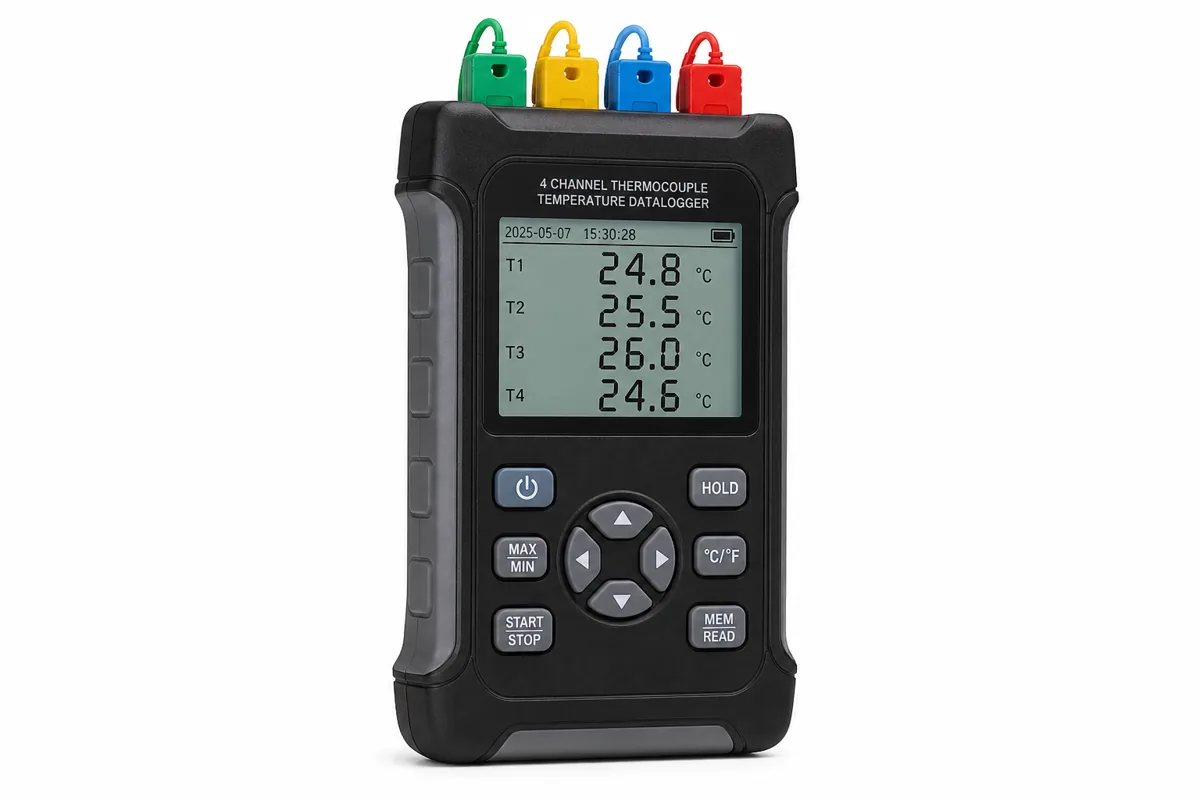
DANOPLUS wireless temperature data logger system

A temperature data logger wireless system is a device that records temperature readings at set intervals and transmits that data without physical cable connections — typically via WiFi, Bluetooth, or RF signal. Simple as that. The logger captures readings (often every 1–60 seconds), stores them internally, and pushes them to a base station, cloud platform, or mobile app for review.

I've used wired thermocouple data loggers in classroom science experiments for years. Brilliant tools. But the cables get tangled, students trip over them, and you can't monitor anything remotely. That's what pushed me toward wireless options about three years ago, and honestly, I haven't looked back.

The core components are straightforward:

  • Sensor probe — K type thermocouple, thermistor, or RTD depending on range needed
  • Data storage — internal memory holding 16,000 to 500,000+ readings
  • Wireless transmitter — WiFi, Bluetooth 5.0, Zigbee, or LoRa radio
  • Software/app — for viewing, exporting, and setting alarm thresholds

If you're already familiar with a thermocouple data logger, think of the wireless version as the same precision instrument — just untethered.

Why Go Wireless in 2026?

Wireless monitoring has gone from luxury to near-necessity this spring. Here's why.

Cost has dropped dramatically. Five years ago, a decent wireless temperature logging setup would set you back £300–£500 per node. Now you can get reliable single-channel units from £28–£80. The DANOPLUS Digital Thermometer, for instance, sits at just £72.11 with free UK delivery in 1–3 days — and that's a precision instrument, not some flimsy gadget from a marketplace seller.

Real-time alerts save stock and reputation

A mate of mine runs a small catering business off the Castlereagh Road. He lost £1,200 worth of frozen stock one bank holiday weekend because his chest freezer failed and nobody knew until Tuesday morning. A wireless logger with SMS alerts would've cost him £60. Painful lesson.

Regulatory pressure is increasing

The Health & Safety Executive has tightened guidance on temperature monitoring in food storage, pharmaceutical warehousing, and workplace environments. Manual spot-checks aren't enough anymore — you need continuous logged evidence. A wireless system gives you timestamped, tamper-proof records that satisfy auditors.

Remote access changes everything

Whether you're checking your greenhouse from the sofa or monitoring a server room from another site entirely, wireless loggers with cloud connectivity mean you're never out of the loop. I check my classroom's humidity and temperature readings from my phone during half-term. Bit obsessive? Maybe. But I caught a heating malfunction in February that could've burst pipes.

Key Features to Look For in a Wireless Temperature Logger

Key features comparison infographic for wireless temperature loggers

Not all wireless loggers are equal. Some are spot on for cold chain monitoring; others are better suited to HVAC air pressure and climate systems. Here's what actually matters.

Accuracy and resolution

±0.5°C accuracy is the baseline you should accept. Anything worse and you're guessing. For pharmaceutical or laboratory use, look for ±0.2°C or better. Resolution of 0.1°C is standard; 0.01°C exists but you'll pay for it.

Measurement range

General-purpose loggers cover -30°C to +60°C. If you need extremes — autoclave monitoring, cryogenic storage — you'll want a K type thermocouple thermometer data logger rated to -200°C to +1370°C. The danoplus K type thermocouple thermometer handles that upper range brilliantly.

Battery life

This catches people out. Cheap units last 30–90 days. Decent ones manage 6–12 months on a single CR2032 or AA cell. If you're placing loggers in hard-to-reach spots — ceiling voids, cold stores, outdoor enclosures — battery life matters enormously.

Wireless range and protocol

Bluetooth: 10–30m typical, up to 100m line-of-sight
WiFi: 30–50m through walls, depends on router
LoRa/RF: 200m–2km+, ideal for large sites
Zigbee: 10–100m, mesh networking extends range

Data export and software

Can you export to CSV or PDF? Does the app work on both iOS and Android? Is cloud storage included or subscription-based? These questions matter more than you'd think. I've seen loggers with great hardware let down by clunky, outdated software — so check reviews specifically about the app experience before you buy.

Multi-channel capability

Need to monitor multiple points simultaneously? A 4-channel thermocouple thermometer lets you track four locations from one device — useful for comparing room zones or monitoring multiple fridges from a single hub.

Types of Temperature Data Logger Wireless Systems Compared

Types of temperature data logger systems reviewed

Here's a breakdown of the main categories available in the UK market as of June 2026. I've tested or handled units from each category, so this isn't just spec-sheet copying.

Type Wireless Protocol Typical Range Battery Life Price Range (UK) Best For
Bluetooth Single-Use BLE 5.0 15–30m 30–90 days £15–£40 Cold chain transit
WiFi Multi-Sensor 802.11 b/g/n 30–50m 6–12 months (ext. power available) £50–£150 Warehouses, kitchens
RF/LoRa Industrial Sub-GHz RF 500m–2km 2–5 years £100–£400 Large facilities, agriculture
Thermocouple + Wireless Hub WiFi/USB relay Probe-dependent Mains powered £28–£200 Lab, HVAC, process monitoring
IoT Cloud Platform WiFi + cellular backup Unlimited (cloud) Mains + battery backup £150–£500 + subscription Regulated industries, pharma

So what's the catch with cheaper Bluetooth units? Range, mostly. They also often require your phone to be within proximity to sync data — fine for a home fridge, useless for a warehouse you visit once a week.

For most small businesses and serious home users, the WiFi multi-sensor category hits the sweet spot — decent range, real-time cloud access, and no monthly fees on most models.

Common Applications Across Industries

Industrial temperature monitoring application

Wireless temperature monitoring isn't just for labs and factories. The range of uses has expanded massively.

Food safety and cold chain

HACCP compliance demands continuous temperature records. A wireless logger in each fridge, freezer, and hot-holding unit gives you audit-ready data without staff manually checking every 2 hours. The UK Government's food safety guidance specifies that chilled food must be kept below 8°C, with best practice at 5°C or below. A wireless alert at 6°C gives you time to act before stock is compromised.

Home environment and indoor air quality

Recurring mould problems? I see this question constantly in online forums. People spend hundreds on mould sprays and dehumidifiers without understanding the root cause. A water quality monitor for pools won't help here — but a temperature and humidity logger placed near problem walls will show you exactly when condensation conditions occur. Usually it's overnight when heating drops and relative humidity spikes above 70%., a favourite among Britain’s tradespeople

Greenhouses and hydroponics

Hydroponic growers obsess over nutrient solution temperature — and rightly so. Root zone temps between 18–22°C are critical. A wireless logger with a waterproof probe in your reservoir, paired with a salinity and temperature meter for nutrient concentration, gives you the full picture without trailing cables through your grow space.

Server rooms and IT infrastructure

Hot spots kill hardware. A wireless logger at rack level — top, middle, bottom — identifies thermal stratification before it causes failures. Set alerts at 27°C and you'll catch cooling issues hours before anything overheats.

Pharmaceutical and vaccine storage

NHS vaccine cold chain requirements specify +2°C to +8°C storage with continuous monitoring. A temperature data logger wireless system with dual alarm thresholds (high and low) and automatic reporting satisfies NHS Green Book requirements for vaccine storage documentation.

Setup and Best Practices

How to set up wireless temperature logger system

Getting a wireless logger working is usually straightforward. Getting accurate, useful data from it? That takes a bit more thought.

Placement matters enormously

Don't stick your logger next to a heat source, air vent, or exterior wall unless that's specifically what you're measuring. For general room monitoring, place it at 1.2–1.5m height, away from direct sunlight, and at least 30cm from walls. Sounds fussy, but I've seen 3–4°C discrepancies from poor placement alone.

Calibration schedule

Even good sensors drift over time. The BSI recommends annual calibration for critical applications, referencing BS EN 12830 for temperature recorders in transport and storage. For home use, a yearly check against a known reference (ice water at 0°C, boiling water at 100°C adjusted for altitude) is sufficient.

Network considerations

WiFi loggers need stable connectivity. If your router drops out at 3am, you'll have gaps in your data. Look for loggers with internal memory buffering — they store readings locally and sync when connection resumes. For sites with poor WiFi coverage, LoRa-based systems or a mesh network of Zigbee nodes work far better than trying to extend WiFi with repeaters.

Logging interval selection

Every 1 second: Process control, rapid thermal events
Every 10–30 seconds: Sound level meter data logging equivalent — detailed but manageable file sizes
Every 1–5 minutes: Cold chain, room monitoring (most common)
Every 15–60 minutes: Long-term environmental studies, battery conservation

Worth knowing: the interval you choose affects battery life dramatically. A logger sampling every 10 seconds and transmitting wirelessly will drain in weeks. The same unit at 5-minute intervals might last a year. Match the interval to your actual need, not what sounds impressive.

UK Regulations and Compliance

UK compliance and regulations for temperature monitoring

If you're using a temperature data logger wireless system for regulatory compliance, you need to know which standards apply.

Food safety (England, Wales, Scotland, NI)

Regulation (EC) 852/2004 (retained in UK law post-Brexit) requires food businesses to maintain cold chain records. Digital loggers with automatic timestamping are accepted — and preferred — by Environmental Health Officers during inspections. Paper logs are still technically valid but increasingly viewed with suspicion.

Pharmaceutical storage

MHRA guidelines require continuous monitoring with calibrated instruments traceable to national standards. Your wireless logger needs a valid calibration certificate, and you must demonstrate an unbroken chain of temperature records. Gaps longer than 30 minutes require documented investigation.

Workplace temperature

There's no legal maximum workplace temperature in the UK — a fact that surprises many people. That said, the Workplace (Health, Safety and Welfare) Regulations 1992 require "reasonable" temperatures. The HSE suggests a minimum of 16°C for sedentary work and 13°C for physical work. A wireless logger provides evidence if you need to raise concerns with your employer, or defend against employee complaints if you're the employer.

Data retention

How long must you keep records? Food safety: minimum 3 months, best practice 12 months. Pharmaceutical: 5 years minimum. Choose a system with adequate cloud storage or easy export to your own archive.

Frequently Asked Questions

How accurate are wireless temperature data loggers compared to wired ones?

Wireless loggers achieve the same ±0.5°C accuracy as wired equivalents when using identical sensor types. The wireless transmission doesn't affect measurement precision — it only changes how data reaches you. K type thermocouple models offer ±0.5°C or better across -200°C to +1370°C ranges. The danoplus range delivers this accuracy at £72.11 with free UK delivery.

What wireless range can I expect through walls and obstacles?

Bluetooth loggers typically reach 10–30m through standard interior walls. WiFi units manage 30–50m depending on your router and building construction. For larger sites, LoRa-based systems achieve 500m–2km even through multiple walls and floors. Metal-clad buildings and cold room insulation reduce all ranges by 40–60%.

Do I need a subscription for cloud-based wireless temperature monitoring?

It depends on the manufacturer. Many WiFi loggers under £100 include free cloud access with basic features. Premium platforms charge £5–£25/month per device for advanced alerting, API access, and extended data retention. Some systems like thermocouple-based loggers store data locally with free PC software, avoiding subscriptions entirely.

Can a wireless temperature logger be used in a freezer at -20°C?

Yes, but choose carefully. The sensor probe must be rated for -30°C or below. Place the wireless transmitter outside the freezer with only the probe cable passing through the door seal — this preserves battery life and signal strength. Internal placement works but reduces battery life by 50–70% due to cold affecting the cell chemistry.

How often should I calibrate a wireless temperature data logger?

For regulated environments (food, pharma), calibrate annually against a UKAS-traceable reference per BS EN 12830 standards. For home and general commercial use, a yearly two-point check (0°C ice bath and boiling water) is sufficient. New loggers should be verified on arrival — don't assume factory calibration is perfect.

What's the best temperature data logger wireless system for a small restaurant?

A WiFi-based system with 3–5 nodes covering each fridge, freezer, and hot-holding unit. Budget £150–£300 total. Look for automatic PDF report generation for EHO visits, SMS/email alerts at threshold breaches, and at least 12 months data retention. The system should log at 5-minute intervals minimum to satisfy HACCP requirements.

Key Takeaways

  • A temperature data logger wireless system eliminates cable clutter and enables remote monitoring — essential for multi-site operations and unmanned locations in 2026.
  • Accuracy of ±0.5°C is the minimum acceptable standard for any serious monitoring application; K type thermocouple systems achieve this across -200°C to +1370°C.
  • WiFi loggers suit most small businesses at £50–£150 per unit, while LoRa systems cover large industrial sites up to 2km range.
  • UK regulations increasingly demand continuous digital records — the HSE, MHRA, and food safety authorities all prefer automated logging over manual checks.
  • Battery life varies from 30 days to 5 years depending on protocol, logging interval, and operating temperature — match these to your specific environment.
  • The danoplus range starts at £72.11 for precision instruments with free 1–3 day UK delivery, offering genuine bang for your buck against premium-priced competitors.
  • Annual calibration is mandatory for regulated use and strongly recommended for all other applications to maintain measurement confidence.

Ready to try DANOPLUS?

Shop Now — £72.11